
Summary
India’s pharmaceutical industry is beginning to move from a manufacturing-led model toward a more technology-driven approach to drug discovery, with AI emerging as an important part of that transition. India has already produced more than 10 novel drug assets over the past decade, while PE/VC investment in pharma increased 2.1-fold to $731 million in FY2026, highlighting growing investor interest in innovation and advanced therapeutics.
AI is adding another dimension to this evolution by helping researchers identify targets, design molecules, analyze biological data, and predict drug responses. NITI Aayog estimates that AI-enabled approaches could potentially reduce R&D costs by 20-30% and shorten drug-discovery timelines by 60-80% when applied across appropriate stages of the development process.
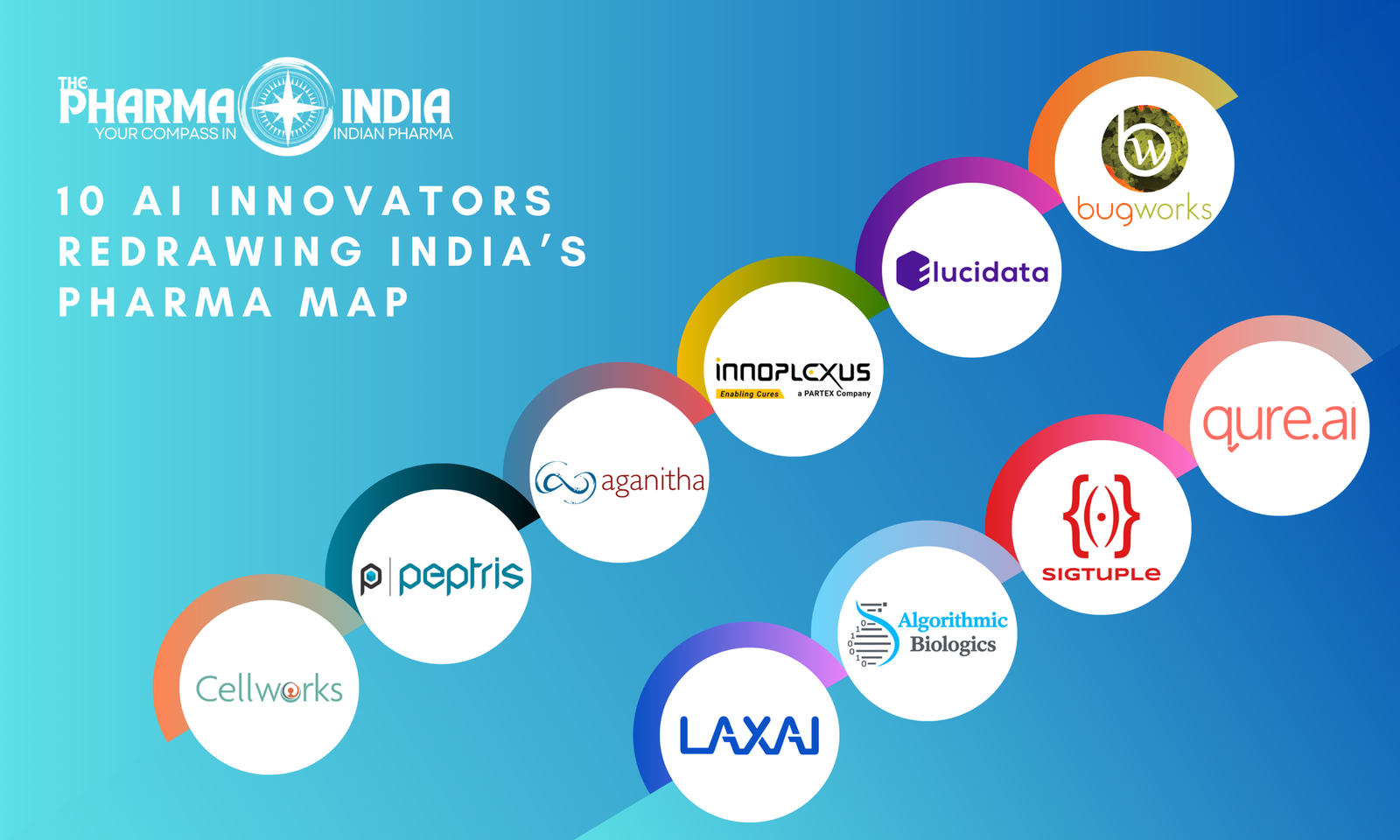
Against this backdrop, a growing group of India-linked AI and computational life-sciences companies is building platforms that address different parts of the pharmaceutical R&D value chain. From Jubilant Therapeutics and Bugworks developing therapeutic candidates to Elucidata and Innoplexus building AI-powered data platforms, and Aganitha, Peptris, and Cellworks applying generative AI, computational biology, and biosimulation, these companies represent different approaches to technology-led pharmaceutical innovation.
This report highlights 10 such innovators and explores how they are using AI and computational technologies to reshape drug discovery, biological research, precision medicine, and healthcare innovation in India.

1. Bugworks Research: Using Computational Innovation to Fight Antimicrobial Resistance
Headquarters: Bengaluru, India
Founded: 2014
Primary R&D Focus: Antimicrobial Resistance, Antibiotic Discovery, Infectious Diseases
AI & Computational R&D Performance
AI-Enabled Antibiotic Discovery
Bugworks is focused on discovering and developing antibacterial therapies against drug-resistant pathogens, an area where traditional antibiotic development has faced significant scientific and commercial challenges.
BWC0977 Development
Its lead antibacterial program, BWC0977, is being developed as an IV and oral step-down treatment for serious infections caused by multidrug-resistant bacteria. The program is identified as Phase 1.
Addressing Drug-Resistant Pathogens
The program targets high-priority pathogens including Acinetobacter baumannii, Klebsiella pneumoniae, and Pseudomonas aeruginosa. The company’s development strategy is closely linked to the global need for new antibacterial mechanisms against resistant infections.
Strategic Highlights
- Advanced novel antibacterial discovery programs.
- Focused on multidrug-resistant infections.
- Developed both IV and oral approaches for BWC0977.
- Expanded collaboration with GARDP for clinical and pharmaceutical development.
Challenges
Antibiotic development faces long clinical timelines, regulatory complexity, resistance evolution, and difficult commercialization economics. Demonstrating clinical efficacy while maintaining activity against evolving bacterial resistance remains a major challenge.
Outlook for 2026
Bugworks is expected to continue advancing BWC0977 and other antibacterial programs while expanding partnerships designed to support clinical development and global access.
Editor’s Take
Bugworks illustrates how technology-enabled drug discovery can be directed toward one of healthcare’s most persistent challenges. Its focus on multidrug-resistant infections gives its computational discovery approach a clear therapeutic and public-health application.

2. Elucidata: Building AI Infrastructure for Data-Driven Drug Discovery
Headquarters: New Delhi, India / Cambridge, U.S.
Founded: 2015
Primary R&D Focus: Multi-Omics, Biomedical Data, AI Infrastructure, Drug Discovery Analytics
AI & Data R&D Performance
Polly Platform
Elucidata’s Polly platform is designed to help drug-discovery teams find, harmonize and analyze multi-omics and clinical data. The platform combines biomedical data integration with AI-powered data processing to make fragmented datasets more usable for research teams.
Supporting Global Life-Science R&D
Elucidata has reported use of Polly by leading life-science organizations, including Pfizer and Janssen. Its earlier Series A announcement stated that more than 30 life-science organizations were using the platform.
AI-Ready Biomedical Data
Polly is positioned as an infrastructure layer for AI-enabled biological research, helping organizations harmonize heterogeneous biomedical datasets before they are used for analytics, machine learning, or research decision-making.
Strategic Highlights
- Built an AI-enabled infrastructure platform for life-sciences data.
- Expanded multi-omics and clinical data capabilities.
- Worked with global pharmaceutical and biotechnology organizations.
- Focused on making biomedical data AI-ready.
Challenges
Biomedical datasets remain fragmented across formats, institutions, experimental systems, and data standards. Maintaining data quality, interoperability, privacy, and reproducibility remains a significant challenge for AI-driven life-sciences platforms.
Outlook for 2026
Elucidata is expected to deepen Polly’s role in AI-enabled drug discovery by expanding data harmonization, knowledge integration, and AI-supported biological research workflows.
Editor’s Take
Elucidata represents a different but essential layer of AI-enabled pharmaceutical innovation. Rather than primarily discovering molecules itself, the company addresses one of the foundational requirements for modern computational biology: turning complex biological data into usable research intelligence.

3. Innoplexus (a PARTEX.AI company): Turning the Life-Sciences Data Ocean Into Actionable Intelligence
Headquarters: Eschborn, Germany
India Operations: Pune, India
Founded: 2011
Primary R&D Focus: AI, Life-Sciences Intelligence, Drug Discovery, Biomedical Data
AI & Data R&D Performance
Ontosight Platform
Innoplexus’ Ontosight platform uses AI and a self-learning ontology to analyze large volumes of structured and unstructured life-sciences information. The platform provides research intelligence across preclinical, clinical, regulatory and commercial workflows.
Large-Scale Data Processing
The platform aggregates and analyzes publications, clinical trials, congress information, treatment guidelines, patents, grants and other biomedical information. The company reports more than 42 million publications, 639,000 clinical trials and 28,600 patents within its data environment.
Pharma Collaboration
Innoplexus reports customers across big pharma, biotechnology, CROs, hospitals and laboratories. Its platform has also been used in AI-driven biomarker and indication-prioritization projects.
Strategic Highlights
- Developed AI-powered life-sciences intelligence capabilities.
- Applied ontology-based technology to biomedical information.
- Supported drug discovery and research decision-making.
- Built an international customer base across pharma and biotechnology.
Challenges
The rapidly expanding volume of scientific information creates challenges in data quality, relevance, validation, duplication, intellectual-property considerations, and maintaining accurate real-time insights.
Outlook for 2026
Innoplexus is expected to continue expanding AI-powered research intelligence and supporting pharmaceutical organizations in navigating increasingly complex scientific and clinical datasets.
Editor’s Take
Innoplexus highlights the importance of intelligence infrastructure in the AI era. Its approach focuses not only on generating new data but on helping scientists extract meaningful connections from the enormous volume of information already available.

4. Aganitha: Combining Generative AI With Deep Science for Therapeutic Discovery
Headquarters: Hyderabad, India
Primary R&D Focus: Generative AI, Computational Biology, Computational Chemistry, Therapeutic Design
AI & Computational R&D Performance
Generative AI for Drug Discovery
Aganitha describes itself as a new-generation in-silico company combining high-throughput science with deep-learning-based generative models to address drug discovery and development challenges.
Igniva AI Platform
Its Igniva platform combines agentic AI, generative AI, computational biology and computational chemistry to support target identification, biomarker research, molecular design and therapeutic development.
Multi-Modality Research
The company works across small molecules, antibodies, enzymes, peptides, ASO, mRNA and gene-therapy applications, alongside computational chemistry and formulation research.
Strategic Highlights
- Integrated generative AI with computational biology and chemistry.
- Developed AI agents for scientific research workflows.
- Expanded capabilities across small molecules and biologics.
- Collaborated with research organizations on therapeutic design.
Challenges
Generative AI in drug discovery must overcome challenges involving biological validation, molecular developability, experimental reproducibility, model reliability, intellectual property, and translation from computational predictions to clinical candidates.
Outlook for 2026
Aganitha is expected to expand the use of agentic AI and computational science across pharmaceutical R&D, with increasing emphasis on integrated scientific workflows rather than isolated AI models.
Editor’s Take
Aganitha reflects the transition from first-generation AI tools toward integrated computational research environments. Its combination of AI agents, scientific expertise and in-silico workflows highlights how AI may increasingly operate alongside scientists throughout the drug-development process.

5. Peptris Technologies: Using AI to Accelerate Preclinical Drug Discovery
Headquarters: Bengaluru, India
Founded: 2019
Primary R&D Focus: AI Drug Discovery, Oncology, Inflammation, Rare Diseases
AI & Computational R&D Performance
AI-Driven Molecular Discovery
Peptris has developed AI models designed to predict properties relevant to drug candidates and reduce the number of compounds requiring experimental testing. Its platform uses approaches derived from neural networks, NLP, large language models and image-processing research.
Preclinical Pipeline
The company reports preclinical assets discovered and validated through in-vitro and in-vivo disease models. Its pipeline includes programs across oncology, inflammation and rare diseases.
DMD Program
Peptris has entered into an exclusive licensing agreement with Revio Therapeutics for PEPR-124, a repurposed candidate being developed for Duchenne muscular dystrophy. The company states that the candidate was discovered using its proprietary AI platform and has received U.S. FDA Orphan Drug Designation.
Strategic Highlights
- Built an AI-native preclinical drug-discovery model.
- Focused on oncology, inflammation and rare diseases.
- Developed proprietary molecular prediction models.
- Advanced an AI-discovered program toward external development.
Challenges
AI-driven discovery still requires extensive experimental validation and preclinical development. Translating computational predictions into robust safety and efficacy profiles remains a central challenge.
Outlook for 2026
Peptris is expected to expand its discovery pipeline and continue advancing AI-generated and repurposed candidates toward preclinical and clinical development through partnerships.
Editor’s Take
Peptris demonstrates how an AI-native biotech can operate with a relatively asset-light discovery model while combining computational design with external experimental capabilities. Its growing pipeline illustrates the increasing role of AI in the earliest stages of therapeutic development.

6. Cellworks: Simulating Drug Response Before Treatment
Headquarters: Silicon Valley, U.S. / Bengaluru, India
Founded: 2005
Primary R&D Focus: Biosimulation, Precision Medicine, Oncology, Computational Biology
AI & Computational R&D Performance
Biosimulation Platform
Cellworks uses mechanistic biology models, multi-omic data, biostatistics and machine learning to simulate how individual patients may respond to therapies. Its platform models molecular interactions and disease biology computationally.
Personalized Therapy Prediction
The platform generates personalized disease models using patient molecular data and evaluates potential therapy responses. Cellworks’ Singula and Ventura products are designed to predict responses to standard-care therapies and combinations of approved drugs.
Drug Development Applications
Cellworks also applies biosimulation to pharmaceutical R&D, including patient selection, therapy optimization, drug-response prediction, drug repurposing and clinical-trial design. The company reports more than a dozen drug assets at different stages of clinical validation.
Strategic Highlights
- Developed mechanistic biosimulation technology.
- Integrated AI and machine learning with biological modeling.
- Applied multi-omics to personalized therapy prediction.
- Expanded computational applications across clinical development and drug discovery.
Challenges
Predictive biosimulation depends on the quality and completeness of biological data and models. Demonstrating predictive performance across diverse patient populations and disease settings remains essential for broader clinical adoption.
Outlook for 2026
Cellworks is expected to continue expanding biosimulation applications across precision medicine, oncology drug development, clinical trials and therapeutic optimization.
Editor’s Take
Cellworks represents a computational approach that goes beyond conventional AI prediction by incorporating mechanistic biological modeling. Its platform illustrates how digital simulations may increasingly complement laboratory and clinical experimentation in pharmaceutical development.

7. Qure.ai: Bringing AI Into Diagnostics and Disease Management
Headquarters: Mumbai, India
Founded: 2016
Primary R&D Focus: Medical Imaging AI, Tuberculosis, Lung Cancer, Clinical Decision Support
AI R&D Performance
AI-Powered Medical Imaging
Qure.ai develops AI-based diagnostic tools designed to support clinicians in detecting and managing diseases through medical imaging. Its platforms cover tuberculosis, lung cancer, stroke and other clinical applications.
Tuberculosis Detection
The company has developed AI solutions for tuberculosis screening using chest X-rays and reports deployments across multiple countries. Its evidence portfolio includes studies evaluating AI-assisted TB diagnosis.
Global Healthcare Deployment
Qure.ai reports that its technology has impacted more than 45 million lives across more than 105 countries and 5,500+ sites.
Strategic Highlights
- Developed AI-based diagnostic imaging solutions.
- Focused strongly on tuberculosis and respiratory disease.
- Expanded into lung-cancer and other clinical applications.
- Built an international deployment footprint.
Challenges
Clinical AI platforms must address regulatory requirements, model validation, interoperability, clinician adoption, data quality and performance across different populations and healthcare environments.
Outlook for 2026
Qure.ai is expected to continue expanding AI-enabled diagnostic pathways while broadening its applications across disease detection, clinical decision support and global health programs.
Editor’s Take
Qure.ai sits at the intersection of AI, diagnostics and healthcare delivery rather than traditional AI drug discovery. Its inclusion highlights the broader role of AI in the pharmaceutical and healthcare ecosystem, particularly in disease detection, patient stratification and clinical decision-making.

8. SigTuple: Automating Digital Microscopy With AI and Robotics
Headquarters: Bengaluru, India
Founded: 2015
Primary R&D Focus: AI Diagnostics, Digital Pathology, Hematology, Urine Microscopy
AI & Diagnostics R&D Performance
AI100 Platform
SigTuple combines robotics, digital microscopy, and AI to automate manual microscopy workflows. Its AI100 platform digitizes blood and urine samples and enables AI-assisted analysis and remote review in diagnostic laboratories.
US FDA 510(k) Clearance
AI100 with Shonit received U.S. FDA 510(k) clearance in September 2023. The FDA classifies the device as a Class II automated cell-locating device for hematology, including white blood cell differential and red blood cell and platelet morphology evaluation.
Expanding Digital Microscopy
SigTuple’s AI100 platform supports peripheral blood smear and urine sediment analysis, with automated cell identification and web-enabled review capabilities.
Strategic Highlights
- Built an India-developed AI and robotics platform for automated microscopy.
- Received U.S. FDA 510(k) clearance for AI100 with Shonit.
- Expanded automated microscopy into urine sediment analysis.
- Enabled cloud-based review and integration with laboratory workflows.
Challenges
Clinical AI diagnostics must meet demanding requirements for analytical performance, regulatory compliance, workflow integration, and adoption by laboratories and pathologists.
Outlook for 2026
SigTuple is expected to continue expanding AI-assisted microscopy applications while strengthening its presence in global diagnostic markets.
Editor’s Take
SigTuple demonstrates how AI can move from software models into physical laboratory workflows through the combination of robotics, imaging, and machine learning. Its FDA-cleared AI100 platform gives the company a tangible example of India-built AI technology entering regulated diagnostic markets.

9. Algorithmic Biologics: Bringing Molecular Computing to the Future of Diagnostics
Headquarters: Bengaluru, India
Founded: 2021
Primary R&D Focus: Molecular Computing, AI-Enabled Diagnostics, Multiplexed Assay Design, Precision Health
AI & Computational R&D Performance
Molecular Computing Platform
Algorithmic Biologics combines mathematics, computer science, and biology to build molecular computing systems that process biological information through algorithms embedded in biochemical reactions. The company describes its technology as an information-processing layer for biotechnology and diagnostics.
AI-Powered Assay Design
The company’s platform is designed to accelerate highly multiplexed molecular assay development, enabling researchers to detect large numbers of targets using fewer reactions. Its technology supports applications across PCR, NGS, diagnostics, biomarker discovery, and research.
Tapestry and Scale-Up
Its Tapestry platform uses software-driven molecular compression and combinatorial multiplexing to improve the scalability and economics of molecular testing. Government-backed startup documentation describes Algorithmic Biologics as developing AI-enabled, large-scale molecular diagnostic tools.
Strategic Expansion
In April 2025, Algorithmic Biologics appointed Hiranjith GH as Chief Business Officer to lead commercial operations and global expansion, particularly in the U.S. The appointment followed his experience at MedGenome, Novartis, ZS Associates, and Accenture, and signals the company’s focus on expanding partnerships and commercialization.
Strategic Highlights
- Developed a molecular-computing platform for biological data processing.
- Applied AI and algorithms to highly multiplexed molecular diagnostics.
- Developed Tapestry for scalable molecular testing.
- Expanded leadership and commercial capabilities in 2025.
- Focused on international expansion and partnerships.
Challenges
Molecular diagnostics companies must navigate regulatory requirements, analytical validation, laboratory integration, adoption by diagnostic providers, and the complexity of scaling novel technologies across different testing environments.
Outlook for 2026
Algorithmic Biologics is positioned to expand its molecular-computing and multiplexed assay technologies across diagnostics, research, and biopharma applications. Its expanded commercial leadership and U.S. focus could support the company’s next phase of partnerships and market development.
Editor’s Take
Algorithmic Biologics represents an interesting next-generation layer of India’s AI-enabled life-sciences ecosystem. Rather than using AI simply as a software tool, the company is attempting to bring computational logic directly into molecular systems. Its combination of molecular computing, multiplexed diagnostics, and expanding global commercial ambitions makes it a strong “who’s next” company for this report.
One correction to your original description: I would not call it simply an “AI-native pharma company.” Its own positioning is broader-molecular computing and AI-enabled molecular diagnostics/research-which makes the above wording more accurate.

10. LAXAI Life Sciences: Integrating Computational Approaches Into End-to-End Drug Discovery
Headquarters: Hyderabad, India
Founded: 2012
Primary R&D Focus: Integrated Drug Discovery, Small Molecules, Computational R&D, CRDMO Services
AI & Computational R&D Performance
Integrated Drug Discovery Platform
LAXAI Life Sciences is a Hyderabad-based contract research, development and manufacturing organization providing integrated small-molecule R&D services. Its discovery model spans target validation, medicinal chemistry, biology, DMPK, toxicology, preclinical candidate selection, process development and manufacturing.
Computational and Data-Enabled Discovery
LAXAI positions advanced technology platforms alongside its scientific capabilities to support drug discovery programs. Its model combines technology-enabled research with medicinal chemistry and biological validation rather than operating solely as an AI software company.
End-to-End R&D Capabilities
The company provides discovery services from early target validation through preclinical candidate selection, followed by development and manufacturing capabilities.
Strategic Highlights
Built an integrated small-molecule drug-discovery and CRDMO platform.
Combined medicinal chemistry, biology, DMPK and toxicology capabilities.
Provided end-to-end support from discovery through development and manufacturing.
Expanded its Hyderabad-based discovery and manufacturing infrastructure.
Challenges
As a CRDMO, LAXAI operates in a competitive market where differentiation depends on scientific capabilities, execution, quality, regulatory compliance, capacity, and the ability to support increasingly complex discovery programs.
Outlook for 2026
LAXAI is expected to continue expanding its integrated discovery, development and manufacturing capabilities while supporting pharmaceutical and biotechnology partners.
Editor’s Take
LAXAI represents a different layer of India’s computational pharma ecosystem from AI-native drug developers. Its strength lies in integrating technology-enabled discovery with medicinal chemistry, biology, development and manufacturing.
Criteria
- Companies were selected based on their use of AI, computational biology, computational chemistry, biosimulation, or AI-enabled technologies in pharmaceutical or healthcare R&D.
- The list focuses on India-linked technology-driven companies, rather than traditional big-pharma companies or general-purpose IT providers.
- Both AI-enabled drug developers and technology/platform companies supporting pharmaceutical R&D were considered.
- Company profiles and pipeline information are based on publicly available company, industry, and institutional sources.