
Executive Summary
India has emerged as a major force in the global pharmaceutical industry, supported by its extensive manufacturing infrastructure, technical expertise and strong presence across international markets. Active Pharmaceutical Ingredients (APIs) remain a critical component of this ecosystem, enabling the production of medicines across a wide range of therapeutic areas. Indian manufacturers have developed capabilities in large-scale production, process chemistry, complex molecules and regulatory-compliant manufacturing, strengthening the country’s position in the global pharmaceutical supply chain.
The API industry is undergoing a gradual transformation as manufacturers expand beyond conventional bulk drugs into complex APIs, high-potency ingredients, custom synthesis and contract development and manufacturing services (CDMO). Investments in research and development, backward integration, manufacturing efficiency and regulatory compliance are becoming increasingly important as companies respond to evolving customer requirements, pricing pressures and the need for reliable pharmaceutical supply chains. These developments are creating opportunities for manufacturers with differentiated product portfolios, strong technical capabilities and established international customer relationships.
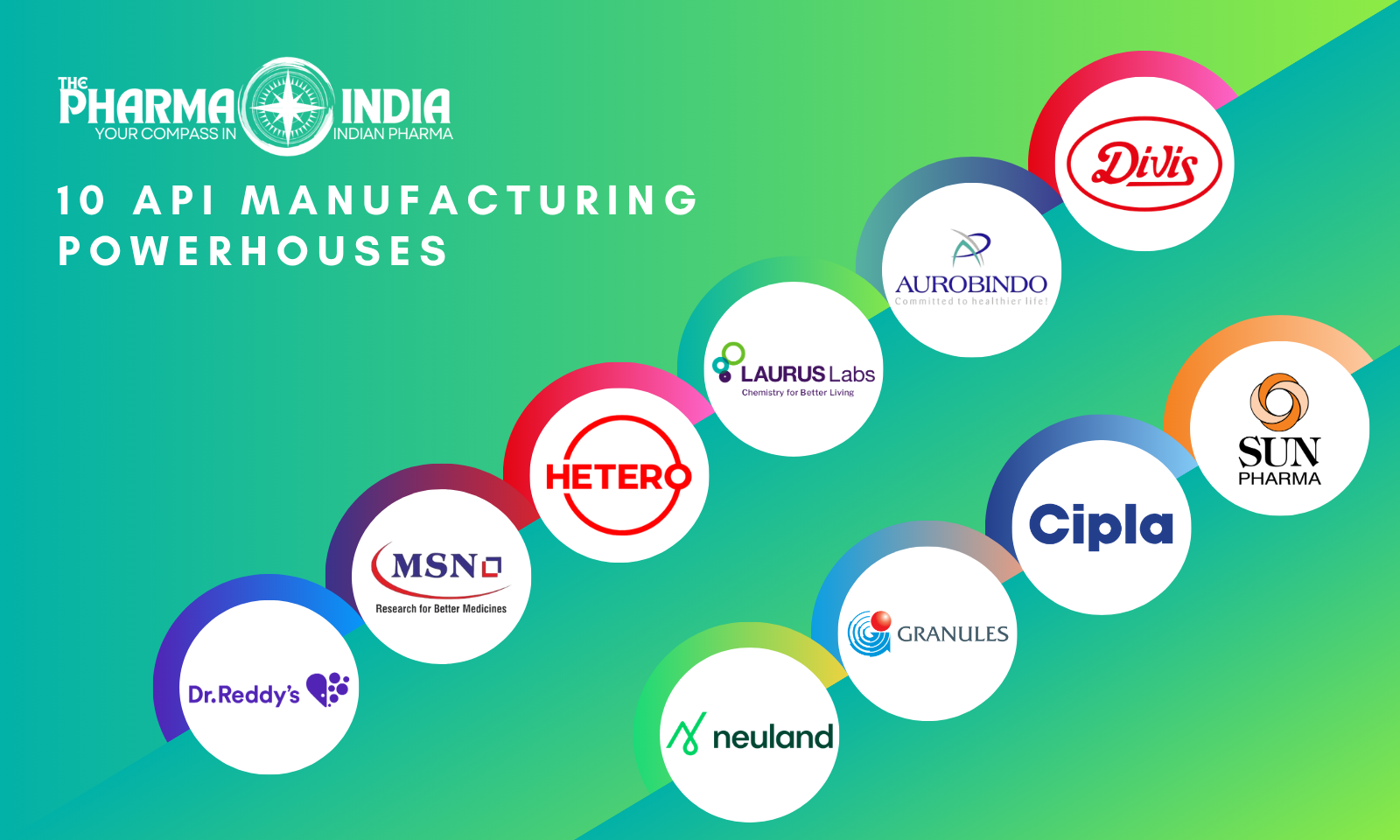
Against this backdrop, several Indian pharmaceutical companies are contributing to the country’s API manufacturing capabilities through distinct business models and areas of specialization. Divi’s Laboratories has established a strong presence in complex chemistry and custom synthesis, while Aurobindo Pharma and Laurus Labs combine substantial API operations with integrated pharmaceutical manufacturing. Dr. Reddy’s Laboratories and Sun Pharmaceutical Industries maintain API capabilities that support their broader pharmaceutical businesses, whereas companies such as Hetero Drugs and MSN Laboratories have developed extensive manufacturing footprints and broad ingredient portfolios. Neuland Laboratories and Granules India further contribute through specialized chemistry, process development and high-volume pharmaceutical manufacturing.
This report profiles 10 prominent API manufacturers in India, examining their manufacturing capabilities, product portfolios, business scale, regulatory presence, international reach and growth opportunities. The assessment considers API-specific revenue where publicly disclosed, alongside manufacturing infrastructure, technical expertise, portfolio breadth and strategic positioning. As several companies operate diversified pharmaceutical businesses or do not disclose standalone API financials, the report uses an editorial assessment of industry relevance and manufacturing capabilities rather than presenting the list as a definitive ranking based solely on API revenue.

Divi’s Laboratories
Building a Global Franchise in Complex APIs and Custom Synthesis
Headquarters: Hyderabad, Telangana, India
Founded: 1990
Primary Business Focus: APIs, custom synthesis, advanced intermediates, nutraceutical ingredients
API Manufacturing Performance
Large-Scale API Manufacturing
Divi’s Laboratories has established a strong position in pharmaceutical ingredient manufacturing, with capabilities spanning selected high-volume APIs, complex chemistry and custom synthesis for global pharmaceutical companies.
Custom Synthesis and Contract Manufacturing
The company’s custom synthesis business supports pharmaceutical innovators through the development and commercial manufacture of intermediates and active ingredients. These relationships can involve complex process development, technical transfer and long-term commercial supply.
International Customer Base
Divi’s serves international pharmaceutical markets and has developed capabilities aligned with demanding customer quality and regulatory requirements. Its combination of commercial manufacturing and custom synthesis gives it a different business profile from manufacturers focused primarily on commodity APIs.
Strategic Highlights
- Established large-scale manufacturing capabilities.
- Strong custom synthesis and contract manufacturing activities.
- Experience in complex chemistry and process development.
- Long-standing relationships with international pharmaceutical customers.
- Portfolio spanning pharmaceutical ingredients and selected nutraceutical products.
Challenges
Custom synthesis programs can require substantial investment, long development cycles and customer-specific capacity. The company must also manage concentration risks associated with major products and customers while maintaining stringent environmental and quality standards.
Outlook for 2026
Opportunities include complex ingredient manufacturing, custom synthesis, process innovation and greater participation in global pharmaceutical development and supply chains.
Editor’s Take
Divi’s Laboratories deserves close attention because its competitive position is not captured by API revenue alone. Custom synthesis, manufacturing expertise and customer relationships are important components of its business model and long-term positioning.
Revenue note: FY2025-26 consolidated revenue was approximately ₹10,560 crore. This figure should not be treated as API-only revenue when comparing companies.

Aurobindo Pharma
Scaling API Manufacturing for Global Pharmaceutical Markets
Headquarters: Hyderabad, Telangana, India
Founded: 1986
Primary Business Focus: APIs, pharmaceutical intermediates, generic formulations, complex generics
API Manufacturing Performance
Integrated API and Formulations Operations
Aurobindo Pharma operates across API manufacturing and finished pharmaceutical formulations. Its integrated business model enables the company to participate in multiple stages of the pharmaceutical supply chain, from active ingredients to finished dosage products.
API Revenue and Business Scale
For FY2025-26, the company reported API business revenue of approximately ₹4,046.9 crore. This is a more relevant measure for API-sector analysis than its consolidated revenue, which includes formulations and other pharmaceutical activities.
International Manufacturing and Market Reach
Aurobindo supplies pharmaceutical products to international markets and operates manufacturing facilities supporting regulated-market requirements. Its scale and established customer relationships provide a foundation for its API business.
Strategic Highlights
- Integrated API and formulation manufacturing capabilities.
- Broad pharmaceutical product and intermediate portfolio.
- Established international distribution and customer relationships.
- Experience supplying products to regulated markets.
- Opportunities to expand complex and differentiated API offerings.
Challenges
API manufacturers face pricing pressure, raw-material cost fluctuations, environmental compliance requirements and increasingly demanding customer quality standards. Aurobindo must also balance API sales to external customers with the requirements of its own formulations business.
Outlook for 2026
Growth opportunities include complex APIs, process efficiencies, greater manufacturing reliability and supply-chain diversification. The company’s ability to maintain margins while developing higher-value products will remain important.
Editor’s Take
Aurobindo Pharma is a significant candidate for a leading position in India’s API manufacturing landscape. Its integrated operations and substantial API business make it particularly relevant to a report examining manufacturing scale and pharmaceutical supply-chain capabilities.

Laurus Labs
Expanding from Generics APIs into Complex Pharmaceutical Manufacturing
Headquarters: Hyderabad, Telangana, India
Founded: 2005
Primary Business Focus: APIs, generic formulations, CDMO services, biotechnology
API Manufacturing Performance
Established API Business
Laurus Labs has built a substantial API business, particularly in selected therapeutic areas, while expanding into formulations, contract development and manufacturing, and biotechnology.
FY2025-26 API Revenue
The company reported API revenue of approximately ₹2,746 crore for FY2025-26, providing a specific segment-level reference for assessing its manufacturing business.
Expansion into CDMO and Biotechnology
Laurus has been developing capabilities beyond conventional API manufacturing, including contract development and manufacturing services and biotechnology-related activities. These businesses provide opportunities to participate in more complex pharmaceutical development programs.
Strategic Highlights
- Established API manufacturing and process chemistry capabilities.
- Experience in selected high-volume therapeutic APIs.
- Expansion into CDMO and biotechnology operations.
- Integrated capabilities across ingredients and finished formulations.
- Potential to increase exposure to complex and higher-value pharmaceutical products.
Challenges
Expansion into new manufacturing areas requires capital investment, technical expertise and sustained quality performance. CDMO projects can also have lengthy development cycles, while demand and pricing in established API markets remain competitive.
Outlook for 2026
The company’s development priorities include strengthening its API business, increasing the contribution of contract manufacturing and biotechnology, and improving utilization as newer capacities mature.
Editor’s Take
Laurus Labs combines a substantial disclosed API business with a broader transition toward complex pharmaceutical manufacturing. Its API revenue provides a useful benchmark for comparison, while its evolving CDMO operations make it relevant to the industry’s longer-term transformation.

Hetero Drugs
Vertically Integrated API Capacity Built on Antiretroviral Leadership
Headquarters: Hyderabad, Telangana, India
Founded: 1993
Primary Business Focus: APIs, finished dosage forms, generics, biosimilars, antiretrovirals (ARVs)
API Manufacturing Performance
Scale of API Operations
Hetero is recognised as the world’s largest producer of antiretroviral drugs and operates what is described as Asia’s largest API SEZ manufacturing complex, with over 1,000 reactors. The company’s company profile cites 11 API manufacturing facilities supporting more than 200 APIs, with six of those sites approved by regulators including the USFDA, EU, TGA, PMDA, KFDA and WHO.
API Revenue and Business Scale
Hetero is privately held and does not publish a separate API revenue line, so API-specific revenue for FY2025-26 is not publicly verifiable. Its manufacturing footprint, regulatory approvals and global supply relationships are the more reliable indicators of scale.
Integrated Operations and Market Reach
Hetero combines process chemistry, API manufacturing and formulation development within one group. Its subsidiaries include Camber Pharmaceuticals in the US, which gives it a route to market for its own APIs and finished products.
Strategic Highlights
- Global leadership in ARV manufacturing.
- Large API SEZ complex with multiple regulator-approved sites.
- Backward integration across discovery, process chemistry, APIs and formulations.
- Portfolio extending into oncology, biosimilars and specialty products.
- Established presence in more than 100 countries.
Challenges
Heavy exposure to ARV and public-health tenders makes pricing and volume sensitive to donor funding and procurement cycles. Limited financial disclosure also makes the company harder to benchmark against listed peers.
Outlook for 2026
Growth opportunities include higher-value APIs, oncology and biosimilar expansion, and greater use of its integrated supply chain. Maintaining regulatory compliance across a large site network will remain central.
Editor’s Take
Hetero is one of the largest API manufacturers in India by physical capacity and ARV leadership, even though its API revenue is not disclosed. It is relevant to any report that weighs manufacturing scale and supply-chain depth alongside reported financials.

MSN Laboratories
Expanding API Breadth Through Integration and Regulatory Filings
Headquarters: Hyderabad, Telangana, India
Founded: 2003
Primary Business Focus: APIs, finished dosage formulations, contract research and manufacturing, oncology and specialty therapies
API Manufacturing Performance
Manufacturing Footprint
MSN states that it operates 17 API and 8 finished dosage facilities across India, the USA, Indonesia and the UAE, with an integrated R&D centre covering both APIs and formulations. Company materials also describe a portfolio of more than 450 APIs and a leading position in active US Drug Master File filings.
API Revenue and Business Scale
MSN is privately held and does not publish audited segment results, so a verified FY2025-26 API revenue figure is not available. Third-party databases estimate total group revenue at roughly US$750 million, but these are unverified estimates and should be treated cautiously.
Vertical Integration
Control over key starting materials and intermediates supports cost competitiveness and supply reliability, particularly in oncology and other complex therapy areas.
Strategic Highlights
- Broad API portfolio spanning oncology, cardiology, CNS and diabetes.
- Strong regulatory filing activity, including US DMFs.
- Integrated API and formulation development under one R&D structure.
- Expanding international manufacturing and distribution footprint.
- Capability in high-potency and complex molecules.
Challenges
Rapid capacity expansion increases the compliance burden across more sites and markets. As a private company, MSN has limited public disclosure, which makes performance harder to verify independently.
Outlook for 2026
Growth will depend on converting its filings and pipeline into commercial supply, extending complex and oncology APIs, and bringing new international facilities up to regulatory standards.
Editor’s Take
MSN is among the fastest-scaling Indian API manufacturers, and its breadth and filing record make it a strong candidate for coverage. Because verified API revenue is unavailable, the case rests on capability and footprint rather than reported numbers.

Dr. Reddy’s Laboratories
PSAI Business Holds Scale Amid Margin Pressure
Headquarters: Hyderabad, Telangana, India
Founded: 1984
Primary Business Focus: APIs and custom pharmaceutical services, generics, branded formulations, biosimilars
API Manufacturing Performance
Pharmaceutical Services and Active Ingredients (PSAI)
Dr. Reddy’s reports its API and contract manufacturing activity under the PSAI segment, which supplies both its own formulations and third-party customers worldwide.
API Revenue and Business Scale
PSAI revenue for the year ended March 31, 2026 was ₹34,773 million (about ₹3,477 crore), a 3% rise from ₹33,846 million in the prior year. The segment’s gross margin fell to 17.2% from 27.1% a year earlier.
Regulatory Depth
During FY26 the company filed 128 Drug Master Files worldwide, taking its total active DMFs to 1,748, of which 280 are in the United States.
Strategic Highlights
- Reported, segment-level API disclosure under PSAI.
- One of the largest DMF portfolios among Indian manufacturers.
- Supply to both internal formulations and external customers.
- Revenue growth sustained despite margin compression.
- Global customer base across regulated markets.
Challenges
The sharp fall in segment gross margin points to pricing pressure and cost inflation in active ingredients. Growth in revenue has not translated into profitability for the segment this year.
Outlook for 2026
Restoring PSAI margins through product mix, process efficiency and higher-value APIs will be the main test. A continued DMF pipeline supports longer-term supply opportunities.
Editor’s Take
Dr. Reddy’s is among the few Indian players that disclose API performance transparently, which makes it a useful reference point for the sector. The revenue growth and margin decline together show the pressures facing API manufacturers.

Sun Pharmaceutical Industries
API Operations Supporting a Global Specialty Generics Platform
Headquarters: Mumbai, Maharashtra, India
Founded: 1983
Primary Business Focus: Branded and generic formulations, innovative medicines, APIs, consumer healthcare
API Manufacturing Performance
API in a Formulations-Led Group
Sun Pharma’s API business primarily supports its own formulations while also serving external customers across geographies. Reported API figures reflect external sales only.
API Revenue and Business Scale
External API sales for FY26 were ₹2,185.3 crore, up 2.6%, with Q4 FY26 API sales of ₹673.9 crore, up 26.4%. This is small relative to the group, whose FY26 revenue from operations was ₹58,462 crore.
Integration Advantage
Internal API supply supports cost control and continuity for a large generics and specialty portfolio, including products sold in the US, India and emerging markets.
Strategic Highlights
- Disclosed external API sales alongside group results.
- Strong Q4 FY26 API momentum after a modest full year.
- Backward integration supporting a large formulations portfolio.
- Global manufacturing network across regulated markets.
- Substantial group financial strength to fund capacity investment.
Challenges
API is a minor share of group revenue, so it receives less strategic emphasis than specialty and branded businesses. External sales can also swing quarter to quarter, as the contrast between Q4 and the full year shows.
Outlook for 2026
The API business will likely stay focused on supporting internal formulations while selectively supplying external customers. Group-level moves, including its announced Organon acquisition, may shift priorities across the portfolio.
Editor’s Take
Sun Pharma is better understood as an integrated pharmaceutical major than a pure API player. Its external API revenue is meaningful in absolute terms, but its importance lies in supporting a much larger formulations franchise.

Cipla
Integrated API Capability in Service of a Diversified Pharmaceutical Portfolio
Headquarters: Mumbai, Maharashtra, India
Founded: 1935
Primary Business Focus: Respiratory, anti-infectives, branded and trade generics, consumer health, APIs
API Manufacturing Performance
Historic API Roots
Cipla has long manufactured APIs, notably for antiretrovirals and respiratory therapies, and continues to use that capability to support its own products.
API Revenue and Business Scale
Cipla reports APIs within an “API and others” line rather than as a standalone segment. In Q4 FY26 this line fell 77% to ₹64 crore. A full-year API figure is not separately disclosed. At group level, Cipla reported FY26 revenue of ₹28,163 crore, up 2% year on year.
Market Reach
The company’s growth is led by its India, Africa and North America businesses, with APIs playing a supporting role.
Strategic Highlights
- Long-standing API manufacturing experience, particularly in ARVs and respiratory.
- Strong integration between API supply and finished products.
- Record annual group revenue in FY26.
- Large net cash position supporting investment capacity.
- Diversified geographic revenue base.
Challenges
The small and volatile “API and others” line shows how limited external API sales are relative to the group. Margin pressure in FY26 also affects how much it can invest in expanding API capacity.
Outlook for 2026
Cipla’s API role is likely to stay supportive of its formulations pipeline, including respiratory and complex generics, rather than evolve into a major merchant business.
Editor’s Take
Cipla is historically significant in Indian API manufacturing, but its current API business is modest and largely captive. It fits a report on pharmaceutical supply-chain capability better than one ranking merchant API revenue.

Granules India
Scaling Pharmaceutical Ingredients and High-Volume Manufacturing
Headquarters: Hyderabad, Telangana, India
Founded: 1984
Primary Business Focus: APIs, pharmaceutical intermediates, pharmaceutical formulations, high-volume manufacturing
API Manufacturing Performance
High-Volume Ingredient Manufacturing
Granules India has developed capabilities across pharmaceutical ingredients, intermediates and finished formulations. Its business model combines scale-oriented manufacturing with participation in different stages of the pharmaceutical supply chain.
Integrated Manufacturing Structure
The company operates across ingredients and formulations, allowing it to serve different customer requirements. This structure can create operational opportunities but also means consolidated financial results do not represent API revenue alone.
Efficiency and Process Improvement
For high-volume pharmaceutical products, manufacturing costs, capacity utilization, yields and supply reliability are important determinants of competitiveness. Process optimization and operational consistency therefore remain central to performance.
Strategic Highlights
- Manufacturing capabilities spanning APIs, intermediates and formulations.
- Experience in large-volume pharmaceutical production.
- Integrated supply-chain participation.
- Opportunities to improve yields, utilization and production efficiency.
- Exposure to domestic and international pharmaceutical markets.
Challenges
Granules faces pricing pressure in established products, raw-material cost movements, customer demand fluctuations and regulatory compliance requirements. Its diversified manufacturing model also complicates direct comparison with API-only businesses.
Outlook for 2026
Growth opportunities include improving operational efficiency, expanding higher-value offerings and strengthening manufacturing capabilities across its pharmaceutical product chain.
Editor’s Take
Granules India is an important manufacturing-scale candidate, but consolidated revenue should not be used as a proxy for API business size. A like-for-like ranking requires segment-level revenue and capacity information.

Neuland Laboratories
Specializing in Complex APIs and Advanced Chemistry
Headquarters: Hyderabad, Telangana, India
Founded: 1984
Primary Business Focus: APIs, complex molecules, custom manufacturing, process development
API Manufacturing Performance
Specialty API Manufacturing
Neuland Laboratories focuses on pharmaceutical ingredients and complex chemistry, serving both generic pharmaceutical customers and innovator companies. Its capabilities include process research, development and commercial-scale production.
Custom Manufacturing Solutions
The company supports customers requiring specialized chemistry, process optimization and commercial manufacturing. Custom manufacturing can create longer-term customer relationships when a process moves successfully from development into commercial production.
Regulated-Market Requirements
Neuland’s business serves customers with demanding quality and regulatory expectations. Its manufacturing systems and process expertise are important factors in its ability to compete in international markets.
Strategic Highlights
- Focus on APIs and complex chemical synthesis.
- Custom manufacturing and process development capabilities.
- Experience supporting innovator and generic pharmaceutical customers.
- Exposure to specialized molecules and higher-complexity chemistry.
- Opportunities to increase participation in complex and differentiated APIs.
Challenges
Specialized manufacturing requires technical investment, process reproducibility and effective management of customer-specific projects. Revenue may also fluctuate with the timing of project development, product launches and commercial orders.
Outlook for 2026
Potential growth drivers include custom manufacturing, complex APIs, improved capacity utilization and additional commercial programs emerging from development-stage relationships.
Editor’s Take
Neuland illustrates why API-sector leadership should not be judged exclusively by overall revenue. Specialized chemistry, process development and customer relationships can be important sources of competitive advantage even when a company is smaller than diversified pharmaceutical manufacturers.
Revenue note: FY2025-26 total revenue has been reported at approximately US$215 million. This should be distinguished from API-only revenue unless a separate segment figure is confirmed.
Conclusion
India’s API sector is moving from bulk-drug volume toward complex chemistry, custom synthesis and CDMO services, and the ten companies profiled show that shift unevenly. Divi’s Laboratories leads on technical depth and customer relationships, while Aurobindo Pharma has the strongest disclosed API scale (₹4,046.9 crore in FY2025-26). Laurus Labs ranks third by combining a reported API business (₹2,746 crore) with a clear move into CDMO and biotechnology.
Hetero Drugs and MSN Laboratories rank on physical capacity, portfolio breadth and regulatory filings rather than reported revenue, since neither discloses API financials. Dr. Reddy’s has the most transparent segment reporting and a large DMF portfolio, but its PSAI gross margin fell from 27.1% to 17.2%, which shows the pricing and cost pressure across the sector. Sun Pharma and Cipla are best seen as integrated formulation companies whose API operations mainly support their own products. Granules India and Neuland Laboratories are smaller, and Neuland’s specialist chemistry shows that scale alone does not capture competitive strength.
Because several leaders do not disclose API-only revenue, the ranking is an editorial assessment, not a revenue league table. Over the next year, the companies best placed to gain are those that add complex APIs and CDMO capacity while keeping margins and regulatory compliance intact.
Ranking criteria
- API scale and capacity: disclosed API or segment revenue, with site count and reactor capacity as proxies where revenue is not reported.
- Technical complexity: depth in custom synthesis, complex or high-potency APIs, process chemistry and CDMO services.
- Regulatory and global footprint: DMF filings, regulator-approved sites (USFDA, EU, WHO) and presence in international markets.
- Growth, integration and transparency: momentum in expansion and margins, backward integration, and how verifiable the company’s API figures are.