
Executive Summary
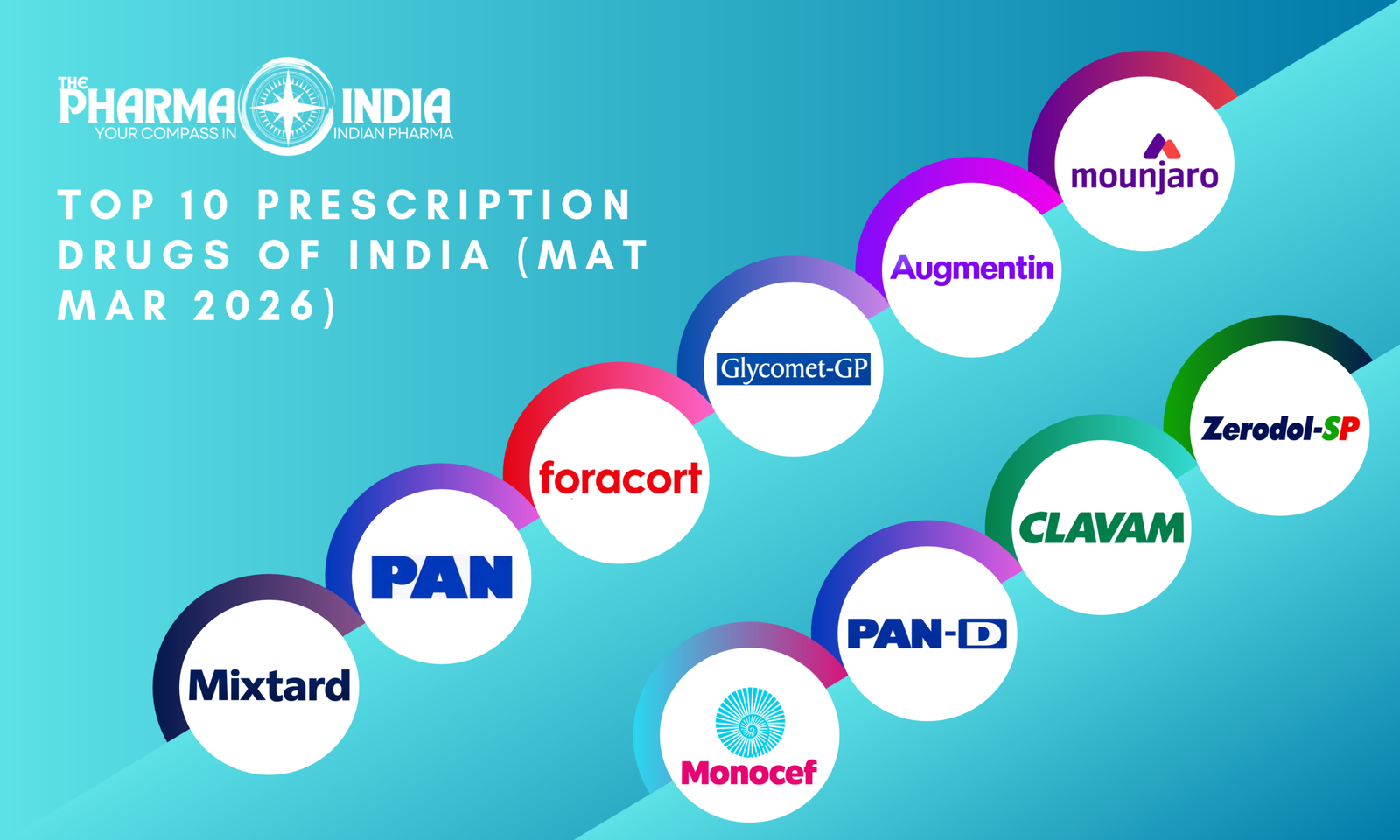
Mounjaro, a diabetes and weight-loss injection that reached India only in 2025, is now the country’s best-selling brand, with ₹923 crore in sales in the 12 months to March 2026. Right behind it is a lineup of old favourites: antibiotics, diabetes pills, inhalers, acid-suppressants and painkillers that doctors have prescribed for years.
Together, the ten brands in this report sold about ₹8,021 crore, roughly 3.3% of the ₹2,45,943 crore Indian pharmaceutical market (IPM). That is a modest slice, which tells you something: no single brand rules the shelf. The market itself grew 8.6% in value but only 0.6% in volume, so most of the growth came from price increases and new launches rather than from selling more packs.
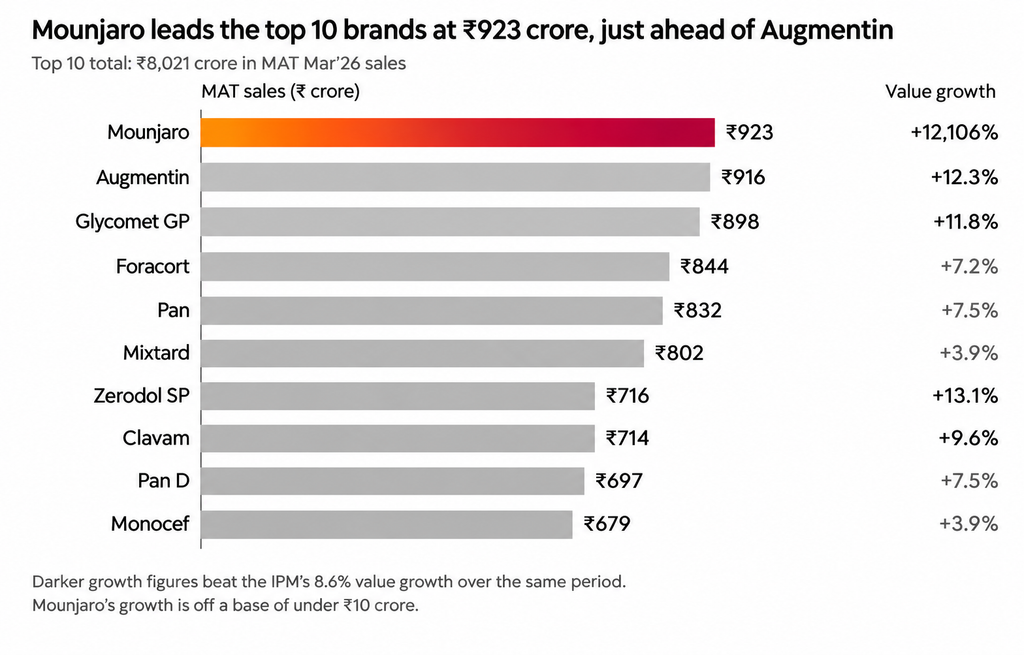
The cast is varied. Eli Lilly, GSK, USV, Cipla, Aristo and Ipca each have a brand on the list, and Novo Nordisk has Mixtard. Alkem is the standout, with three brands (Pan, Clavam and Pan D) worth ₹2,243 crore between them.
This report profiles the 10 best-selling brands in India, looking at what each one is, how it performed, where it is strong, where it is exposed and what to watch next. Unlike an editorial list, the order here follows one number: MAT sales value for March 2026 from Pharmarack’s PharmaTrac data. One heads-up: the data stops at March 2026, so treat it as a snapshot, especially for Mounjaro, which was just meeting its first generic competition when the period closed.

Mounjaro
The Newcomer That Took the Crown in Under a Year
- Marketed by: Eli Lilly and Company (India)
- Active ingredient: Tirzepatide
- Therapy area: Diabetes and weight management
- Launched in India: 2025
- MAT Mar’26 sales: ₹923 crore (Rank 1)
Brand Performance
From Almost Nothing to No. 1
Mounjaro sold ₹923 crore in the year to March 2026, up 12,106% on a base of under ₹10 crore. It also ranks first on monthly sales, with about ₹100 crore in March 2026 alone. That is an unusually steep launch curve.
A Brand That Is Most of Its Company
Mounjaro makes up roughly 85% of Eli Lilly’s ₹1,086 crore India sales and about 58% of the whole GLP-1 agonist market (₹1,579 crore). That market has tripled in a year, from ₹527 crore in MAT Mar’25, and Mounjaro is driving it.
The Semaglutide Twist
Generic semaglutide arrived in the last ten days of March 2026. Across the tirzepatide market, monthly sales slipped from ₹135 crore in February to ₹114 crore in March, and Lilly’s share of GLP-1 sales fell from 69% in October 2025 to 56% in March 2026. Pharmarack points out that semaglutide, whether generic or from the innovator, is far cheaper than tirzepatide.
Strategic Highlights
- No. 1 at both MAT and monthly level within about a year of launch.
- Unit sales up 4,625.5%, so real demand, not only price.
- Sits in the fastest-growing corner of the diabetes market.
- Gives Eli Lilly a top-40 corporate rank in India, at No. 38.
Challenges
The brand carries a lot of weight: when one product is about 85% of a company’s India business, any dip matters. Cheaper semaglutide generics are now a direct threat, and Pharmarack flags that stricter government advisories on GLP-1 use could narrow prescribing to eligible patients.
Outlook for 2026
Pharmarack expects more aggressive semaglutide launches from April 2026. In past generic launches, unit sales jumped 2x to 3x before settling after three to four months. The test for Mounjaro is whether its premium price survives that wave, and later Pharmarack releases will show how it played out.
Editor’s Take
Mounjaro is the headline of this report, and it deserves a little scepticism alongside the applause. The ₹923 crore reflects a year of near-open-field growth, and March gave us the first sign of real competitive pressure. Whether it keeps the top spot depends on how well it defends its price against semaglutide.
Sales note: MAT Mar’26 covers April 2025 to March 2026. The 12,106% growth is off a very small base and should not be read as a repeatable rate.

Augmentin
The Antibiotic Veteran That Keeps Outgrowing Its Category
- Marketed by: GSK
- Active ingredient: Amoxicillin with clavulanic acid
- Therapy area: Anti-infectives
- MAT Mar’26 sales: ₹916 crore (Rank 2)
Brand Performance
A Quiet Climb to No. 2
Augmentin sold ₹916 crore in the year to March 2026, growing 12.3% in value and 9.1% in units. Pharmarack notes it moved up to second place at MAT level. In March 2026 alone it sold ₹76 crore, ranking third that month.
Beating a Shrinking Category
Here is the interesting bit. Anti-infectives as a whole grew 5.4% in value, while units fell 1.6%. Augmentin more than doubled the category’s value growth and grew volume by 9.1% while the category shrank.
A Big Slice of GSK India
Augmentin accounts for nearly 18% of GSK’s ₹5,163 crore in sales, ahead of Calpol (₹406 crore) and T Bact (₹381 crore). For a company ranked 14th in the IPM, that is a lot riding on one antibiotic.
Strategic Highlights
- Strong brand recall in a category where doctors often stick with trusted names.
- Unit growth of 9.1% against a falling category.
- Value growth of 12.3%, so price and mix helped but did not do all the work.
- A clear lead over its closest rival, Clavam, which sits at No. 8.
Challenges
Antibiotic use is under growing scrutiny because of antimicrobial resistance, and any tightening of prescribing rules could hit volumes. Branded generics of the same combination are everywhere, so Augmentin depends on its name and doctor loyalty to hold its price.
Outlook for 2026
The brand is well placed to keep growing ahead of anti-infectives, as long as it keeps winning share from competing versions of amoxicillin-clavulanate. The thing to watch is whether its March monthly growth of 9.0% holds or drifts further below the 12.3% annual rate.
Editor’s Take
Augmentin is proof that an old brand can still grow faster than its market. It is not glamorous, but at nearly ₹916 crore it is one of the most dependable franchises in Indian pharma.
Sales note: MAT Mar’26 sales of ₹916 crore. GSK’s share is calculated against the ₹5,163 crore corporate total in the same Pharmarack data.

Glycomet GP
The Diabetes Pill Combination Growing on Price, Not Packs
- Marketed by: USV
- Active ingredients: Metformin with glimepiride
- Therapy area: Anti-diabetic
- MAT Mar’26 sales: ₹898 crore (Rank 3)
Brand Performance
Third Place, Just Behind Augmentin
Glycomet GP sold ₹898 crore in the year to March 2026, up 11.8% in value. Pharmarack says it moved to third place at MAT level. In March 2026 alone it sold ₹73 crore, ranking fourth that month.
Price Is Doing the Heavy Lifting
Value grew 11.8% but units grew only 1.1%, and in March 2026 units actually fell 3.1%. In plain terms, nearly all of the growth came from higher prices or a richer mix, not from more patients or more packs.
USV’s Anchor
Glycomet GP is about 18% of USV’s ₹5,008 crore in sales. Add Ecosprin AV at No. 20 (₹529 crore, up 18.1%) and these two brands together make up roughly 28% of the company.
Strategic Highlights
- Combination of two long-established diabetes drugs that doctors know well.
- Value growth of 11.8% comfortably beat the IPM’s 8.6%.
- Part of a company with two brands in the top 20.
- Operating in a therapy that grew 11.3% in value over the year.
Challenges
Newer treatments are taking the growth in diabetes. New products contributed 8.1 of the anti-diabetic therapy’s 11.3 percentage points of growth, and a lot of that is GLP-1 injections like Mounjaro. Flat unit growth suggests Glycomet GP is defending its position rather than expanding it.
Outlook for 2026
Expect steady value growth as long as pricing holds, with units flat to slightly down. The risk is that more patients move to newer drug classes, so watch whether March’s 3.1% unit decline turns into a trend.
Editor’s Take
Glycomet GP is the kind of brand that rarely makes headlines but pays a lot of bills. It is strong and trusted, and its challenge is that the diabetes market’s excitement is now somewhere else.
Sales note: MAT Mar’26 sales of ₹898 crore. Company shares are calculated against USV’s ₹5,008 crore corporate total in the same data.

Foracort
Cipla’s Inhaler Powerhouse, With a Surprise March
- Marketed by: Cipla
- Active ingredients: Formoterol with budesonide
- Therapy area: Respiratory (asthma and COPD)
- MAT Mar’26 sales: ₹844 crore (Rank 4)
Brand Performance
Steady Annual Numbers
Foracort sold ₹844 crore over the year, up 7.2% in value and 1.3% in units. That is slightly slower than the respiratory therapy overall, which grew 11.2% in value and 7.9% in units.
A Very Different March
Then came March 2026: ₹83 crore in sales, up 31.7% in value and 10.6% in units, and good enough for No. 2 on the monthly chart. Pharmarack does not explain the jump, so treat it with care. Respiratory brands can swing with seasons and base effects, and one strong month does not make a trend.
A Whole Franchise, Not Just One Brand
Foracort is one of three Cipla respiratory brands in the top 20, alongside Duolin (₹605 crore, No. 14) and Budecort (₹531 crore, No. 19). Together they bring in about ₹1,980 crore, nearly 14% of Cipla’s ₹14,421 crore in sales.
Strategic Highlights
- A combination inhaler that doctors know and trust.
- Part of a deep respiratory portfolio that covers many patient needs.
- Strong March momentum in both value and units.
- Backed by Cipla’s reputation in respiratory care.
Challenges
Annual growth of 7.2% trails both the respiratory therapy and the wider market’s 8.6%. Inhaler brands also face competition from other combination products, so Foracort has to keep earning its place.
Outlook for 2026
The question is whether March’s surge is the start of a stronger run or a one-month spike. If units keep growing by around 10%, Foracort could close the gap with the brands just above it.
Editor’s Take
Foracort is a reminder that India’s top brands are often franchises in disguise. Read it alongside Duolin and Budecort and you see Cipla’s respiratory strength more clearly than any single brand shows.
Sales note: MAT Mar’26 sales of ₹844 crore. The ₹1,980 crore franchise total is the sum of Foracort, Duolin and Budecort MAT sales in the same data.

Pan
The Acid Reflux Staple Holding Its Own in a Shrinking Category
- Marketed by: Alkem Laboratories
- Active ingredient: Pantoprazole
- Therapy area: Gastrointestinal
- MAT Mar’26 sales: ₹832 crore (Rank 5)
Brand Performance
Outpacing the Gut Category
Pan sold ₹832 crore in the year to March 2026, up 7.5% in value and 0.4% in units. That may sound ordinary, but look at the category: gastrointestinal products grew only 4.1% in value, while units fell 4.9%. Pan grew faster on both measures.
A Softer March
Monthly sales were ₹70 crore, ranking fifth, with value up 1.7% and units down 1.9%. The annual picture is stronger than the latest month, so keep an eye on whether momentum is fading.
Alkem’s Biggest Bet
Pan is about 8% of Alkem’s ₹10,134 crore in sales. Counting Clavam and Pan D, Alkem’s three top-10 brands add up to ₹2,243 crore, or roughly 22% of the company.
Strategic Highlights
- Outgrew its therapy on both value and units.
- Anchors a brand family that also includes Pan D.
- Reached No. 5 in a market with intense competition in pantoprazole.
- Gives Alkem its largest single brand on the list.
Challenges
Pantoprazole is a crowded molecule with many competing brands, and the gastro category’s falling volume shows how hard growth is. Pan’s near-flat unit growth means price is doing most of the work.
Outlook for 2026
Expect continued modest growth, driven by price and a steady prescriber base. The monthly numbers from March are the ones to track.
Editor’s Take
Pan is a lesson in the power of a strong brand name in a commodity-like molecule. Nobody gets excited about acid-suppressants, yet this one has built a ₹832 crore business and keeps beating its category.
Sales note: MAT Mar’26 sales of ₹832 crore. Alkem’s totals are calculated from the brand and corporate figures in the same Pharmarack data.

Mixtard
The Insulin Workhorse Selling More Packs for Less Money Per Pack
- Marketed by: Novo Nordisk
- Active ingredient: Premixed human insulin
- Therapy area: Anti-diabetic (insulin)
- MAT Mar’26 sales: ₹802 crore (Rank 6)
Brand Performance
Volume Is Growing Fast
Mixtard sold ₹802 crore over the year, up 3.9% in value but 12.0% in units. In March 2026 the gap widened: value rose 6.9% while units jumped 24.3%, putting monthly sales at ₹58 crore and a ranking of eighth.
What the Gap Tells Us
When units grow three times faster than value, the average price per pack is falling. Pharmarack does not say why, so the cause could be lower prices, a shift to cheaper packs or both. What it does show is that more patients are getting Mixtard.
A Sister Brand Going the Other Way
Ryzodeg, also from Novo Nordisk, at No. 18, sold ₹558 crore, down 5.3% in value and 4.8% in units. Between the two, the Novo Nordisk insulin pair brings in about ₹1,360 crore.
Strategic Highlights
- Unit growth of 12.0%, the strongest of any established brand in the top 10 except Mounjaro.
- Part of an insulin portfolio that gives patients long-term treatment options.
- Benefits from the wider growth of the anti-diabetic therapy.
- From Novo Nordisk, a global diabetes leader.
Challenges
Growing volume with thin value growth means revenue per pack is under pressure, and Mixtard’s value growth of 3.9% sits well below the IPM’s 8.6%. Competition from newer injectables, including GLP-1 drugs, is also changing the diabetes treatment mix.
Outlook for 2026
If unit growth continues near 12%, value should eventually follow, but only if pricing stabilises. Watch whether March’s 24.3% unit jump is a new run rate or a one-month spike.
Editor’s Take
Mixtard is a volume story. It is reaching more patients, which is good news for access, but it is not yet turning that reach into matching revenue growth.
Sales note: MAT Mar’26 sales of ₹802 crore. Pharmarack lists Mixtard and Ryzodeg under Abbott (Novo); here they are treated as Novo Nordisk brands, and the ₹1,360 crore total is simply the sum of the two.

Zerodol SP
The Painkiller Combination Racing Ahead of Its Category
- Marketed by: Ipca Laboratories
- Active ingredients: Aceclofenac, paracetamol and serratiopeptidase
- Therapy area: Pain and analgesics
- MAT Mar’26 sales: ₹716 crore (Rank 7)
Brand Performance
Double the Category’s Growth
Zerodol SP sold ₹716 crore in the year to March 2026, up 13.1% in value and 6.0% in units. The pain and analgesic therapy managed 6.5% value growth and a 2.2% fall in units, so Zerodol SP grew value at about twice the category’s pace and added volume while the category lost it.
March Made It Even Better
Monthly sales were ₹64 crore, ranking sixth, with value up 22.0% and units up 13.9%. That is a clear acceleration compared with the annual numbers.
Ipca’s Big Earner
Zerodol SP is about 15% of Ipca’s ₹4,773 crore in sales, which makes it a major pillar for a company ranked 17th in the IPM.
Strategic Highlights
- Fastest value growth of any established brand in the top 10, at 13.1%.
- Growing in both value and volume in a category where volumes are falling.
- Accelerating: March growth of 22.0% beats the annual rate.
- A combination product that fits common orthopaedic and pain prescriptions.
Challenges
Pain is a crowded category with many similar combinations and heavy price competition. Analgesic prescribing also draws regulatory attention from time to time, which can affect combination products specifically.
Outlook for 2026
Zerodol SP has momentum and room to climb. If March’s pace holds, it could move up the ranking, but sustaining growth above 20% would be hard for any brand of this size.
Editor’s Take
Zerodol SP is the most convincing growth story among the established brands on this list. It is gaining on value, volume and monthly rank at the same time, and the question is how long that can last.
Sales note: MAT Mar’26 sales of ₹716 crore. Ipca’s share is calculated against its ₹4,773 crore corporate total in the same Pharmarack data.

Clavam
Alkem’s Answer to Augmentin, Still Chasing the Leader
- Marketed by: Alkem Laboratories
- Active ingredient: Amoxicillin with clavulanic acid
- Therapy area: Anti-infectives
- MAT Mar’26 sales: ₹714 crore (Rank 8)
Brand Performance
A Solid Performer in Its Own Race
Clavam sold ₹714 crore in the year to March 2026, up 9.6% in value and 4.5% in units. Monthly sales were ₹60 crore, ranking seventh, with value up 8.8% and units up 1.7%. Like Augmentin, it is growing faster than the anti-infectives category, which grew 5.4% in value with units down 1.6%.
The Augmentin Gap Is Widening
Clavam contains the same combination as Augmentin, so the two compete head to head. Augmentin leads by ₹202 crore, and because it is growing faster (12.3% against 9.6%), that gap is wider than a year ago, when it was roughly ₹164 crore.
Another Alkem Pillar
Clavam is about 7% of Alkem’s ₹10,134 crore in sales. With Pan and Pan D, Alkem owns three of the top ten.
Strategic Highlights
- Growing in value and volume while the category’s volume falls.
- Value growth of 9.6% beat the IPM’s 8.6%.
- Gives Alkem a strong anti-infective brand next to its gastro strength.
- Benefits from broad prescriber familiarity with the molecule.
Challenges
Clavam is competing against the category leader with a product that is, by composition, the same. That leaves it fighting on brand, relationships and availability rather than on clinical difference. Antibiotic stewardship rules could also limit volumes for every brand in the category.
Outlook for 2026
Expect continued steady growth, but probably not enough to catch Augmentin. March’s unit growth of 1.7% is a lot slower than the annual 4.5%, so watch whether volume momentum is cooling.
Editor’s Take
Clavam is a strong brand that happens to live next to a stronger one. It is doing everything right and still seeing the leader pull away, which is how competition in mature categories often feels.
Sales note: MAT Mar’26 sales of ₹714 crore. The earlier gap of about ₹164 crore is derived from the MAT growth rates of Augmentin and Clavam, not a figure Pharmarack reports directly.

Pan D
Pan’s Younger Sibling, Squeaking Into the Top 10 on Price
- Marketed by: Alkem Laboratories
- Active ingredients: Pantoprazole with domperidone
- Therapy area: Gastrointestinal
- MAT Mar’26 sales: ₹697 crore (Rank 9)
Brand Performance
Near the Bottom of the List
Pan D sold ₹697 crore in the year to March 2026, up 7.5% in value but down 2.2% in units. It sits ninth in this ranking and ninth for March 2026 as well (₹57 crore).
March Took a Turn
Monthly value growth was just 0.3%, while monthly units fell 8.8%. Those are the weakest March numbers in this report.
The Pan Family
Pan and Pan D together sold about ₹1,529 crore, which is around 15% of Alkem’s ₹10,134 crore. Both brands grew value at 7.5%, but Pan is holding volume better.
Strategic Highlights
- Part of the Pan family, which has two brands in the top 10.
- Value growth matches Pan’s at 7.5%.
- Targets patients who need acid control along with relief from nausea or bloating.
- Outgrew the gastro category’s 4.1% value growth.
Challenges
Units fell 2.2% over the year and 8.8% in March, a sign that prescribers or patients may be moving away from the combination. With value growth at 7.5% against an IPM of 8.6%, it is also growing slower than the market.
Outlook for 2026
If March’s volume weakness continues, Pan D could slip down the list, and Monocef is only ₹18 crore behind it. Its fate depends on whether it can stabilise units, since price increases can only carry value growth so far.
Editor’s Take
Pan D is the brand on this list with the narrowest margin for error. It sits on the 9th rung with Monocef right behind it, and its volume is softening, so a few quarters of weak numbers could change the picture.
Sales note: MAT Mar’26 sales of ₹697 crore. The Pan family total of ₹1,529 crore is the sum of Pan and Pan D in the same Pharmarack data.

Monocef
The Injectable Antibiotic Stepping Into the Top 10
- Marketed by: Aristo Pharmaceuticals
- Active ingredient: Ceftriaxone
- Therapy area: Anti-infectives
- MAT Mar’26 sales: ₹679 crore (Rank 10)
Brand Performance
A Late Entrant to This List
Monocef sold ₹679 crore in the year to March 2026, up 3.9% in value and 2.5% in units. It was No. 11 in Pharmarack’s own table and moves up to tenth here because Liv.52 is excluded. In March 2026 it sold ₹51 crore, with value up 6.9% and units up 5.3%.
Growing Volume in a Shrinking Category
Anti-infectives as a whole grew 5.4% in value while units fell 1.6%. Monocef grew units by 2.5%, so it is gaining ground on volume, though its value growth of 3.9% trails the category.
A Third Antibiotic Brand
With Augmentin and Clavam, antibiotics now take three places in the top 10, together worth about ₹2,309 crore. Monocef is about 10% of Aristo’s ₹6,921 crore in sales, and Aristo’s Pantop and Mikacin also sit in Pharmarack’s top 40.
Strategic Highlights
- Gained volume while the anti-infective category lost it.
- March growth of 6.9% in value and 5.3% in units beat the annual pace.
- An injectable antibiotic that is widely used in clinics and hospitals.
- Anchors Aristo, a company ranked 12th in the IPM.
Challenges
Ceftriaxone is a well-known molecule with many competing brands, so Monocef has to compete on trust and availability. Antibiotic stewardship rules could also limit volumes, and value growth of 3.9% is below both the category and the IPM’s 8.6%.
Outlook for 2026
Monocef is only ₹18 crore behind Pan D, and Udiliv is about ₹25 crore behind Monocef, so its position is far from safe. If March’s momentum holds, it could climb a place.
Editor’s Take
Monocef is the newcomer to this list, and it earns its place quietly. It is not growing fast, but it is adding volume where its category is not.
Sales note: MAT Mar’26 sales of ₹679 crore. Monocef’s rank, and its monthly rank of 11th, are recalculated after removing Liv.52 from Pharmarack’s table.
Conclusion
India’s top 10 is one newcomer and nine veterans. Mounjaro took the top spot in about a year, while Augmentin, Glycomet GP, Foracort, Pan and the rest keep winning through habit, trust and steady pricing. Five of the ten beat the IPM’s 8.6% value growth (Zerodol SP, Augmentin, Glycomet GP, Clavam and Mounjaro), and five trailed it (Pan, Pan D, Foracort, Mixtard and Monocef).
The volume picture is more revealing. Five brands grew units by 4% or more (Mounjaro, Mixtard, Augmentin, Zerodol SP and Clavam), four grew only modestly, by 2.5% or less (Glycomet GP, Foracort, Pan and Monocef), and one fell (Pan D). Across the whole market units grew just 0.6%, so brands that add volume are doing something special.
Company concentration is the other theme. Mounjaro is about 85% of Eli Lilly’s India sales, and Augmentin and Glycomet GP are each close to 18% of GSK’s and USV’s. Alkem and Cipla look safer because they spread the risk: Alkem across three top-10 brands, Cipla across three respiratory brands.
Looking ahead, the big test is Mounjaro against cheaper generic semaglutide. Zerodol SP has the best momentum among established brands, while Pan D is the one to watch for slipping. This report uses data to March 2026, so later Pharmarack releases will show whether the order has changed.
Ranking criteria and data notes
- Ranking basis: MAT Mar’26 sales value in ₹ crore, as shown on page 23 of Pharmarack’s presentation. MAT means the 12 months from April 2025 to March 2026. Herbal and nutraceutical products are excluded, which removes Liv.52 (No. 7 in Pharmarack’s table), so ranks here differ from page 23 from seventh place down. Monthly ranks are recalculated the same way.
- Growth figures: value and unit growth as reported by Pharmarack for the MAT period and for March 2026 alone.
- Derived figures: company shares, brand-family totals and the Augmentin-Clavam gap are calculated from Pharmarack’s numbers and rounded.
- Descriptions: active ingredients, therapy areas and general positioning come from general industry knowledge, not from Pharmarack.
- Caveat: Pharmarack tracks market sales, so figures may differ from the revenue companies report themselves.
Sources